



Wiccan Symbols and Meanings: Complete Guide
Updated by Taylor Tobin
Wicca is a spiritual practice focused on the power of nature and celebration of moon phases, sun cycles, and elemental energy. Many Wiccans also use forms of magic or symbols for healing and ceremonial purposes, and while certain traditions are widely observed in the Wiccan community, the faith as a whole celebrates individuality and encourages adherents to practice Wicca in a way that works for them.
Although Wicca doesn't have a centralized "church" or a strict set of rules and regulations, its use of symbols helps to unite all practitioners around a shared spiritual language. Whether you're a white witch, green witch, or practicing kitchen witchery, understanding these symbols deepens your connection to ancient wisdom and modern practice.
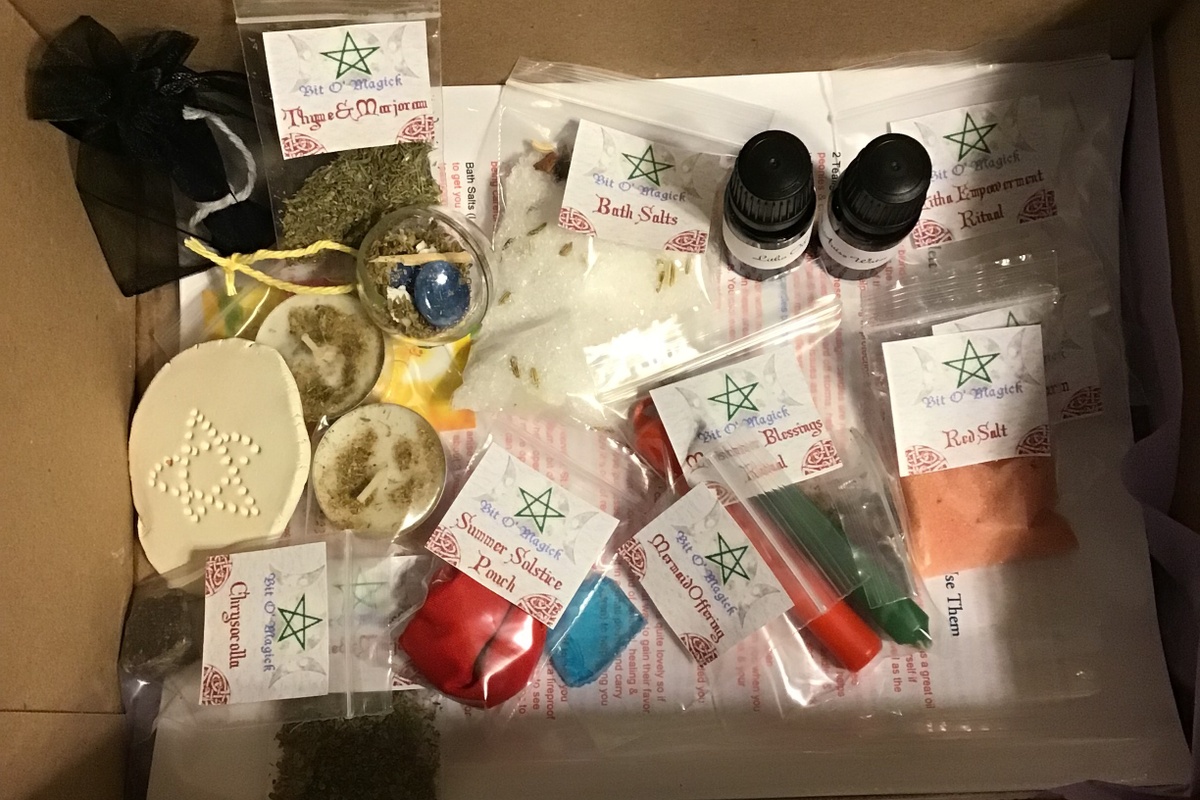
We're exploring the meanings and uses of essential Wiccan symbols with the help of Mike Sexton, the creator of Bit O'Magick Monthly Wicca Box.
Pentagram and Pentacle
Perhaps the most widely-recognized symbols associated with Wicca are the pentacle and the pentagram. A pentagram is a five-pointed star, while the term "pentacle" refers to a disc or circle with the pentagram inscribed on or in it.
"The points of the star represent the elements of earth, air, water, fire, and spirit. In the case of the pentacle, the circle around it is a protective element [that] connects all of the [other] elements together," Sexton explains. "This powerful symbol [is often used in] protective work and when placing wards around home and property. For example, I will draw a pentacle with my finger when placing protections on my doors, windows, and property, and I will even trace it on my dog when he's feeling under the weather. On the altar, a pentacle is often used to focus energy."
Triple Moon
Traditional Wiccan practices involve the worship of two deities, although some Wiccans object to the notion of "worship" and instead view their relationship with the divine as one of collaboration.
The first of these figures is the Triple Goddess, a force that takes on three forms much as the God of Christian doctrine includes the Father, the Son, and the Holy Ghost. In Wicca, the Goddess encapsulates the Maiden, the Mother, and the Crone, with each form representing both a phase of life and a phase of the moon. The Triple Moon symbol is a visual expression of the facets of the Goddess, made up of a circular "full moon" (which stands for the Mother) flanked on the left by a crescent moon shape (for the Maiden) and on the right by another crescent (the Crone).
"The Triple Moon is often used as a symbol of strength and a reminder that the Goddess is always there. That's why you often will find this symbol made into jewelry and tattoos," Sexton notes.
The Horned God
While the Triple Moon is a symbol of the Goddess, the feminine Wiccan deity, a circle topped with an upturned crescent represents the Horned God, Wicca's divine masculine figure. In her writings, celebrated Wiccan author Doreen Valiente refers to the Horned God as "the personification of the life force energy in animals and the wild." The Horned God is aligned with the energy of the sun—just as the Goddess is connected to the moon—and the symbol stands for wild and sometimes unpredictable forces of nature that work with the power of the Triple Goddess to create balance and harmony.

Triquetra (Trinity Knot)
Also known as a Trinity Knot, the triquetra is perhaps most famous for its appearances on pieces of jewelry (and tattoos!) inspired by Celtic mythology. Because modern-day Wicca often pays homage to ancient Celtic traditions of worship, this symbol has become an important part of the Wiccan visual language. The triquetra represents the "power of three" which is a central tenet of Wiccan belief and practices, including the Triple Goddess and the triad of earth, water, and fire. The triquetra has also been used to honor Morrigan, the Celtic goddess of battle, who plays a role in some Wiccan practices. The unbroken line used to draw the triquetra symbolizes solidarity in the context of Wiccan rituals and ceremonies.
Elemental Symbols
The four classical elements—earth, air, fire, and water—form the foundation of much Wiccan practice, and each has its own symbolic representation. Earth is typically shown as an inverted triangle with a horizontal line through it, representing stability and grounding. Air appears as an upright triangle with a horizontal line, symbolizing communication and intellect. Fire is depicted as an upright triangle, embodying transformation and passion. Water is represented by an inverted triangle, reflecting intuition and emotion. Many Wiccans incorporate these symbols into altar arrangements, ritual circles, and spell work to invoke the specific energy of each element.
Wheel of the Year
The Wheel of the Year symbol represents the annual cycle of eight sabbats—seasonal celebrations marking solstices, equinoxes, and cross-quarter days. This wheel-shaped symbol typically features eight spokes, each representing one of the pagan holidays: Samhain, Yule, Imbolc, Ostara, Beltane, Litha, Lammas, and Mabon. The circular design emphasizes the cyclical nature of life, death, and rebirth, reminding practitioners that every ending brings a new beginning. Many Wiccans display this symbol on their altars or use it as a focal point when planning seasonal rituals and celebrations.
The Ankh
While originally an ancient Egyptian symbol, the ankh has been adopted by many modern Wiccans as a representation of eternal life and divine balance. The loop at the top represents the sun rising over the horizon, while the cross beneath symbolizes the material plane. Together, they represent the union of masculine and feminine energies and the eternal nature of the soul. Some practitioners incorporate the ankh into protection spells or wear it as jewelry to connect with ancient wisdom and affirm their belief in life beyond the physical realm.
Celtic Knots and Spirals
Celtic knotwork, featuring intricate interwoven patterns with no beginning or end, symbolizes the interconnectedness of all things and the eternal cycle of life. The spiral, another prominent Celtic symbol, represents growth, evolution, and the journey inward toward spiritual awakening. These symbols are particularly meaningful in green witchcraft and nature-based practices, as they reflect the patterns found throughout the natural world—from unfurling ferns to the arrangement of seeds in a sunflower.
Frequently Asked Questions About Wiccan Symbols
What is the most powerful Wiccan symbol?
The pentacle is often considered the most powerful protective symbol in Wicca, representing the five elements (earth, air, fire, water, and spirit) unified within a protective circle. However, the "most powerful" symbol is ultimately personal to each practitioner based on their specific practice and connection.
Can anyone use Wiccan symbols?
Yes, Wiccan symbols can be used by anyone drawn to their meanings, though it's important to approach them with respect and understanding of their spiritual significance. Many people wear Wiccan symbols as jewelry or incorporate them into their spiritual practice regardless of whether they formally identify as Wiccan.
What's the difference between Wiccan and pagan symbols?
Wicca is a specific pagan religion, so many Wiccan symbols overlap with broader pagan symbolism. However, Wicca has specific deities (the Triple Goddess and Horned God) and practices that give certain symbols unique significance within the Wiccan tradition compared to other pagan paths.
Are Wiccan symbols used in spells?
Yes, many Wiccans incorporate symbols into spell work, altar arrangements, and rituals to focus energy and invoke specific elemental or divine forces. Symbols can be drawn, carved into candles, inscribed on tools, or visualized during meditation and magic work.
Where can I learn more about using Wiccan symbols in practice?
Beyond reading guides like this, consider subscribing to a witch subscription box that includes educational materials, or explore books by respected Wiccan authors like Doreen Valiente and Scott Cunningham.
Deepen Your Wiccan Practice
Ready to explore more about Wiccan symbols and spiritual practice? Check out these related guides: