





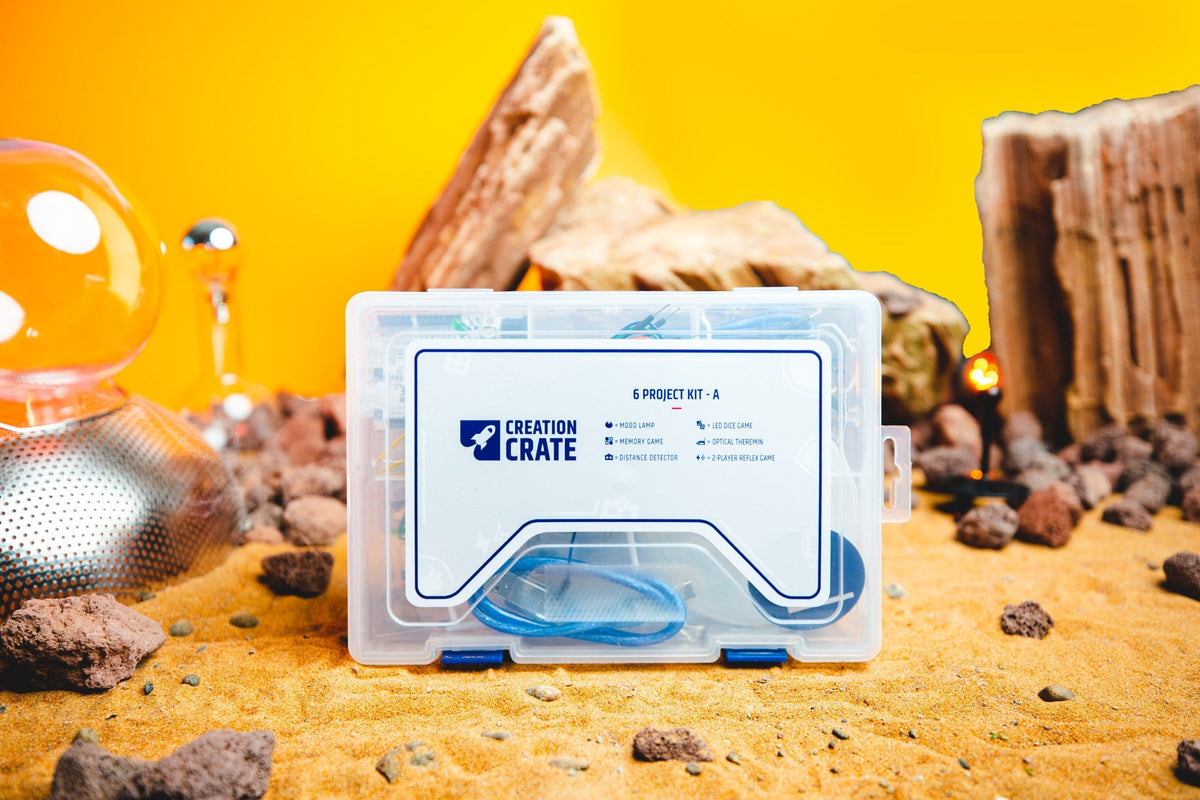
The reference box
What makes Creation Crate different
Creation Crate teaches electronics and coding one Arduino project at a time. Each kit pairs an Arduino-compatible Uno R3 board with the parts for one build, and an online classroom walks you through the wiring and code. The 18-project curriculum starts with a mood lamp and works up to an FM tuner.
- Ages
- Recommended for 12 and up.
- What you learn
- Breadboard circuits and the Arduino language (C/C++), starting from zero, on a computer with a USB port.
- Pace
- One project a month, each a step harder than the last.
Compare the boxes
| Box | Best fit | Cost and commitment | Delivery |
|---|---|---|---|
| Creation Crate Reference box |
Ages 12 and up, Arduino coding from zero | One kit per project, 18 in the full curriculum. | One project a month. |
| TechCrate Pro | Ages 12 and up, a new board and code each month | $39.99 a month, cancel anytime. | Ships free the first week of each month. |
| STEM Discovery Boxes | Ages 7 to teens, three projects a month | $35 a box month to month. | Monthly. First box ships in 1–3 business days. |
| CrunchLabs Hack Pack | Ages 14 and up, a programmable robot | About $67 a box on a prepaid year. Shortest plan is six months. | Every other month. |
| KiwiCo Eureka Crate | Ages 12 and up, hands-on builds without code | $30 a crate month to month, cancel anytime. | Monthly, free US shipping. |
| HackerBoxes | Adult hobbyists who solder | $44 a month, cancel anytime. | Ships near the end of each month. Free US shipping. |
| Curiosity Box | Teens and adults, ages 12 and up | About $350 prepaid for four boxes. | Every three months. |
STEM Discovery Boxes and Eureka Crate both cost less per box on longer prepaid plans.
The alternatives
The closest match
TechCrate Pro vs Creation Crate
See TechCrate Pro on protechtrader.com →
Best for: A teen 12 or older, or an adult, who wants the heart of Creation Crate: a microcontroller, the parts to wire to it, and the code to make it all run.
TechCrate comes from ProTechTrader, the company behind the official Make: Electronics component kits. Its Pro tier sends a programmable board every month (an Arduino-compatible Nano, an ESP32 with Wi-Fi and Bluetooth, or a Raspberry Pi Pico) with three to five sensors and modules, such as OLED screens, servos, and distance sensors.
What feels familiar
You wire each project on a breadboard and program it in C++ in the Arduino IDE, the same Arduino language Creation Crate uses. The code comes commented and explained, and the guides push you to change it and write your own.
What changes
The guides cover MicroPython as well as C++, and projects reach into Wi-Fi gadgets and smart-home builds. The Pro tier is written for people who’ve already built simple circuits. If that’s not you yet, the $14.99 base TechCrate sends a breadboard circuit project each month for ages 10 and up with supervision. There are no reviews on the Pro tier yet, so you’d be an early subscriber.
A younger builder, three projects a month
STEM Discovery Boxes vs Creation Crate


Best for: A 10- to 13-year-old who’s curious about circuits and code and would happily try chemistry and physics too.
STEM Discovery Boxes sends three projects a month to kids from 7 through the teen years (grades 2–8), drawn from electronics, chemistry, physics, coding, hydraulics, and more.
What feels familiar
Every supply is in the box, and electronics and coding are among the subjects it covers, so a kid who liked Creation Crate’s early projects still gets circuits and code to work on.
What changes
The box mixes subjects instead of building one skill month after month, and it’s aimed younger than Creation Crate’s 12-and-up recommendation. The monthly plan renews until you cancel, with no year to sign up for.
A teen who wants robots
CrunchLabs Hack Pack vs Creation Crate
See Hack Pack on crunchlabs.com →
Best for: A builder 14 or older who’d rather program a robot than a mood lamp.
Hack Pack is Mark Rober’s subscription for teens. Every other month brings a programmable robot with an Arduino microcontroller and battery in the box, plus a Mark Rober video. The first box is an infrared turret.
What feels familiar
Each robot runs on an Arduino microcontroller. The robots work right out of the box, then you change how they behave in CrunchLabs’ coding console, so a beginner can start and a confident coder can go further.
What changes
Boxes come every other month, and there’s no month-to-month plan: the shortest commitment is six months, and the lowest price per box needs a prepaid year. It’s built for 14 and up, older than Creation Crate’s starting age. For younger engineers, see our CrunchLabs alternatives.
Hands-on builds without code
KiwiCo Eureka Crate vs Creation Crate
See Eureka Crate on kiwico.com →
Best for: A teen or adult who liked putting Creation Crate’s projects together more than writing the code.
Eureka Crate is KiwiCo’s line for ages 12 and up. Each month brings one engineering build that’s meant to be used afterward, such as a pinball machine or a table tennis robot wired with motors.
What feels familiar
A complete kit every month, with instructions and the science behind the build, for the same 12-and-up crowd.
What changes
The builds are mechanical, some with motors and wiring, and none of KiwiCo’s example crates include a board to program. If coding was the part your builder loved, start with TechCrate Pro instead. For more boxes for younger kids, see our KiwiCo alternatives.
An adult ready to solder
HackerBoxes vs Creation Crate
See HackerBoxes on hackerboxes.com →
Best for: An adult who finished Creation Crate’s projects and wants harder ones.
HackerBoxes sends a surprise box each month for hobbyists in electronics, computing, and cybersecurity: components, modules, and tools, with a free online guide for every box. The company says its monthly boxes are meant for adult hobbyists.
What feels familiar
New hardware arrives every month with a written guide to work through at your own pace, and members trade notes in forums on Instructables and Facebook, a bit like Creation Crate’s message board.
What changes
You’re expected to solder, and you’ll need a computer, wire cutters, small screwdrivers, and basic soldering tools. Contents are a surprise, and boxes can’t be returned once they ship. If you’ve never soldered, HackerBoxes sells a one-time Soldering Workshop kit to learn on first.
A science gift for teens and adults
Curiosity Box vs Creation Crate


Best for: A curious teen or adult who’d enjoy a science gadget and the lesson behind it more than a breadboard.
Curiosity Box by Vsauce arrives every three months with science gadgets, hands-on experiments, and books, and each item is paired with an original Vsauce lesson. Every edition is made once and not repeated.
What feels familiar
It’s for ages 12 and up, adults included, and it teaches how things work through objects you can hold.
What changes
There’s nothing to wire or program, and a new box comes every three months instead of every month. You pick a t-shirt size at checkout, and you can send the year as a gift that doesn’t renew.
The honest part
What none of these replace
Creation Crate builds one skill on one platform: 18 projects in a set order, each building on the last, all programmed in Arduino C++, with one-on-one help by email, phone, or video when a build won’t work. No box here copies that whole package. TechCrate Pro comes closest to the format, Hack Pack to coding for teens, and HackerBoxes to a long-term hobby.
How we chose these boxes
We started with what Creation Crate is built around: a monthly Arduino project with every part, an online lesson, and code to write, for ages 12 and up. Then we looked for subscriptions that keep part of that, whether it’s a board to program, electronics to build, or the same teen-and-adult audience. Two are independent sellers on Cratejoy, and four sell from their own sites. The photo at the top is Creation Crate’s own image of its 6 Project Kit.
Questions before you choose
What’s a good Creation Crate alternative for a 12- or 13-year-old?
Hack Pack starts at 14, so look at TechCrate Pro for Arduino-style coding, Eureka Crate for builds without code, or STEM Discovery Boxes for a mix of electronics, coding, and other sciences.
Do I need to know how to code?
Not for Hack Pack: CrunchLabs says its robots work right out of the box, and you learn to change them from there. TechCrate Pro is written for people who have already built simple circuits, and the base TechCrate covers those first. HackerBoxes expects soldering skills.
Is there a monthly Arduino subscription box?
TechCrate Pro is the closest: a programmable board, sensors, and step-by-step code every month, and you can cancel anytime. HackerBoxes also comes monthly but is aimed at adult hobbyists who solder. Hack Pack uses an Arduino microcontroller too, but ships every other month.
Which of these can I give as a one-time gift?
STEM Discovery Boxes and Curiosity Box, the two Cratejoy boxes on this list, can both be sent as a gift subscription that’s paid once and doesn’t renew. KiwiCo also sells Eureka Crate as a gift.
